Pill Box Care
Medication Management App
Healthcare UX Certification Case Study
Pill Box Care is a mobile app that helps caregivers track medications and progress and gives clinicians access to medication history and analytics, supporting more informed diagnostic assessments and treatment decisions.

The Problem
Medication management is fragmented across disconnected tools, and existing apps lack key features.
This gap drives real harm: missed doses, dangerous interactions, and clinicians making decisions from memory instead of data. PillBox Care addresses this by connecting all three roles around one reliable, permission-based record.
Model
Healthcare UX Case Study
Role
Main Product Designer
Skills
Research, Strategy, UI, UX, IA
PHASE 1
Research
Target Demographic for PillBox Care
Defining who the app serves was essential to guide a first draft of features for different users that have distinct needs, permission levels, and levels of independence, and understanding these groups shaped the app's core structure from the ground up.
AI-generated visualization: These images were created using AI to help illustrate real-life scenarios of use, and to build empathy with the challenges people face when managing complex medication schedules.


Social Listening - Reddit
Sample:
The comments shown here represent a small sample. The pain points were identified through qualitative analysis of more than 50 Reddit comments.

No tracking — > A patient doesn't realize how much of the treatment they have to go with.
Weak interaction checking —> Someone starts a new antihistamine, unaware it interacts with a sleep med they already take.
Apps lose to pillboxes on simple cases —> A grandparent just uses a $5 weekly pillbox, nothing complex enough to justify an app.
Lacking accessibility —> A blind man can't tell which pill he's confirming, since the app's button has no label for his screen reader.

Initial Findings- Research Papers
The real scale of medication non-adherence and the documentation gaps clinicians face today.
PHASE 2
Free Exploration
Key Features - Initial Assumptions
This is a highly exploratory list of features, compiled from social listening and surface-level research, organized by user view → patient, caregiver, and clinician. The purpose is to establish an initial grasp of the design direction and the app's potential capabilities, and how the three views might connect to and support one another.
Patient View
Medication management, smart reminders, , and progress tracking..
Caregiver View
Full or partial medication management for one or multiple patients
Clinician View
Access based view of medication history, current regimen & analytics.
Design Iterations - ( exploratory session)
This first version of the prototype was intentionally exploratory with no boundaries.
Every possibility was considered, regardless of how impractical, unconventional, or seemingly unnecessary it appeared. Removing self-imposed restrictions at this stage encouraged genuinely creative thinking beyond predefined limits. The result is a wide pool of ideas that can now be reviewed, prioritized, validated, and refined in later iterations.


PHASE 3
Prioritization
Feasability & Ethical Considerations
Each feature is assessed for implementation complexity and potential impact on user safety, privacy, and autonomy.
Feasibility reflects the technical effort and dependencies required at MVP scope. Ethical considerations account for the sensitivity of health data and the vulnerability of users managing ongoing medication, flagging risks around data privacy, misinterpretation, and harm.


Usability Testing
A usability testing session was conducted with potential patients and a few pharmacists to better understand gaps and pain points in the design. The sessions revealed 9 issues to be resolved or optimised, ranging from clarity of dosage information and missed dose logging, to caregiver permissions, alert customisation, and data safety

Refined Prototype ( Patient App Only)
PillBox Care is split into two companion apps > PillBox Care for Patients, designed for personal use and PillBox Care for Caregivers, built for medical personnel, family, and friends supporting someone on a treatment plan.
This prototype covers the patient app only and represents the current MVP scope, a work in progress that reflects decisions informed by user testing, feasibility assessments, and ethical considerations. Features have been prioritized to deliver the core medication management experience, with further iterations planned as the product evolves.

PHASE 4
Deep Design
Authentication Flow ( Patient vs Caregiver)
Two distinct onboarding paths designed to serve different user needs while maintaining shared security standards.
1.Login vs Signup Patient App
The patient onboarding flow guides users through account creation in three steps: personal profile, medical information, and accessibility preferences, before landing on a personalised home screen ready to track their first dose.

2.Login vs Signup Caregiver App ( Medical Personnel-full access)
The medical caregiver flow requires professional credential verification before granting full access. Accredited personnel, nurses or doctors, submit their licence number and a signed consent form from the patient or their family, ensuring that clinical-level access is always authorised and traceable.
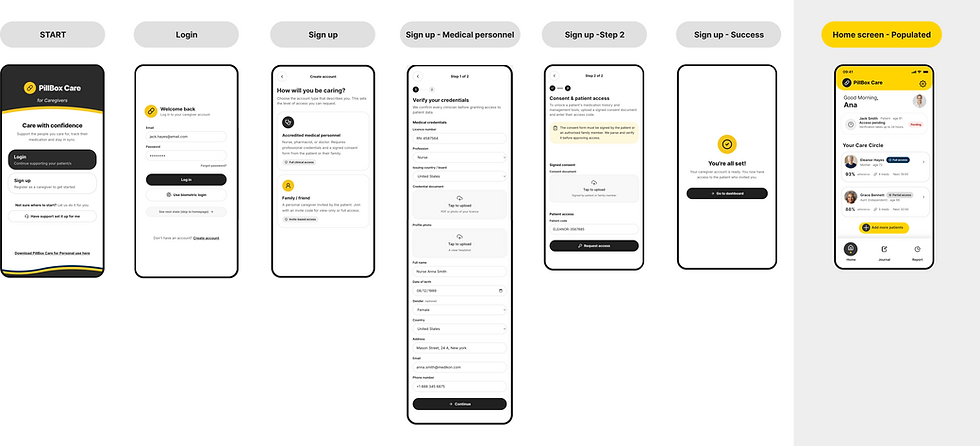
3.Login vs Signup Caregiver App ( Family/Friends-permission based access)
The caregiver flow is built around trust and consent to accommodate a family member or friend that is invited with prior approval and the specific permissions set directly by the patient,

Key Accessibility Features
PillBox Care is built to work for everyone from day one. Users can personalise how the app looks, sounds, and communicates, with settings for larger text, high contrast, symbol coding, audio guidance, vibration and light alerts, and reduced motion.


Responsible AI Integration
AI use in healthcare-related apps has proven to be delicate
.The strategy here is to make it as unintrusive as possible, guiding users without taking over their agency. The AI does not make medical recommendations, and it does not automate processes that are sensitive.
Two features in PillBox Care leverage AI in a way that informs without replacing clinical judgement.
1. The first is a potential medicine interaction alert . The feature is strictly advisory: it flags, explains, and defers — it never diagnoses or recommends action.—> When the app detects a possible interaction between two or more medications in a user's list, it surfaces a brief, plain-language explanation of what that interaction could mean, and prompts the user to check with their doctor before making any changes.
2. The second is a possible suggestion for symptom causes —> When a user logs a symptom or side effect, the app surfaces a brief, AI-generated note suggesting which medication in their list may be associated with it — based on known side effect profiles. The suggestion is timestamped, non-diagnostic, and always framed as a possible link rather than a confirmed cause. The user can share this log directly with their doctor, who makes the final clinical assessment.
Both features are designed with a clear boundary: AI and curated content exist to reduce confusion and build health literacy, not to substitute professional medical advice


Error Prevention
Medication logging needs to be forgiving. Two common mistakes are accounted for directly in the flow.
If a user marks a medicine as taken by mistake, an undo option is immediately available — no navigation required, no data lost.
If a dose is showing as missed but the user simply forgot to log it, an Update CTA lets them retroactively mark it as taken, with the app confirming the action before applying it. Neither mistake results in a dead end.


HIPAA & GDPR Compliance Assessment
The following table outlines the regulatory requirements that PillBox Care App is committed to meet.
As the app is currently in early stages of development, this serves as a working compliance framework, mapping HIPAA and GDPR standards against the app's planned features and data practices, to ensure that privacy, security, and user rights are built into the product from the ground up rather than addressed as an afterthought.
